1397 Strategy for AI Development in China
- Джимшер Челидзе
- Aug 23, 2025
- 9 min read

Updated: Aug 29, 2025
In the previous article we highlighted 4 key insights from our trip to China.
The first is the mass implementation of AI. In every city there are clusters, accelerators, hundreds of startups. Alipay already has built-in AI assistants, and in the subway you can see ads for cloud services for AI.
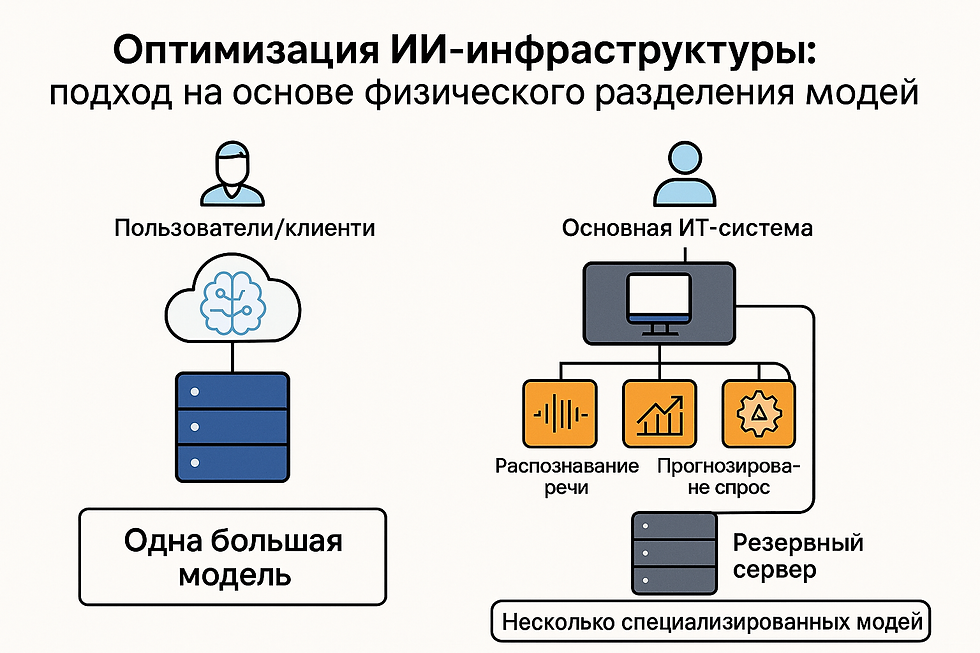
The second is a focus on practical models. Despite all the talk about “strong AI,” most experts are confident that the future lies in compact, accessible, and specialized solutions built into specific processes and coordinated by other models.
Third, infrastructure is the foundation of everything. Automation, sensors, robotics, fast and stable communications, high-quality data. All of this forms the basis for the large-scale implementation of AI in production and everyday life.
Fourth - scale and speed. The level of robotization in China is 10+ times higher than in Russia. This is not just technology for the sake of technology, but a real increase in efficiency and a basis for developing new solutions. In addition, they do not do pilot projects for years, but quickly test innovations and either scale them up or abandon them.
All this is impossible without a common strategy and long-term planning. And we want to share an example of strategic thinking. This is the “1397” strategy, which was formulated in Zhejiang Lab (based in China AI Town, Hangzhou). So, let's figure it out.
1 - Single strategic goal - focus on intelligent computing
This is the central goal of the entire strategy - to make intelligent computing in AI and machine learning a top priority to achieve leadership and practical results.
3 - Three strategic needs/areas of development
This is what tasks we will solve using calculations.
National Strategic Frontiers
Solving strategic tasks for the state and strengthening technological sovereignty.
Scientific and technological innovation and transformation
Stimulating fundamental scientific discoveries and technological change: fundamental research in AI, cognitive science, algorithms, creation of technological platforms (cloud services, supercomputers, data networks)
Innovations in strategic industries
Modernization and intellectualization of key sectors of the economy, design of industrial application scenarios (robotics, smart cities, medicine, industrial AI).
9 – Nine priority areas of research
This is how we will address strategic needs.
Group 1: Important transformational/cross-cutting tasks
1. Support for large/strategic/research international projects
Example: Participation in the ITER (International Thermonuclear Experimental Reactor) project.
How it works: Intelligent computing is used for sophisticated plasma simulations, real-time experiment control (predicting and suppressing instabilities), processing exabytes of data from thousands of sensors, and reactor design optimization.
Result: Accelerating the path to a commercial fusion reactor—an inexhaustible source of energy.
2. Support for large/strategic/research national scientific projects
Example: Chinese space program (e.g. Chang'e lunar program or Tianwen Mars program).
How it works: Create a distributed computing network between ground control centers, orbiters, and landers. AI processes surface images to select landing sites, manages autonomous navigation, and analyzes scientific data (such as soil composition) on the spot.
Result: Increased autonomy and mission success in conditions of high communication delays.
Group 2: Driver tasks or driving force
3. Use of scientific and technological innovations in key areas
Example: Discovery of new drugs and materials.
How it works: Using AI to predict the properties of millions of molecules (virtual screening), which speeds up the search for drug candidates for cancer or Alzheimer's disease by a thousand times. Similarly, AI models new materials with desired properties (e.g., room-temperature superconductors, new batteries).
Result: Reduction of development time and cost from decades to years.
4. Promoting the implementation of intelligent solutions in advanced manufacturing
Example: "Dark Factory" or "smart" factory.
How it works: In a fully automated electronics factory (like Huawei or Xiaomi), real-time intelligence optimizes the entire supply chain: computer vision systems monitor product quality, robotic arms adapt to changes in the assembly line, and predictive analytics predict the need for machine maintenance before it breaks down.
Result: A dramatic increase in production efficiency, quality and flexibility.
Group 3: Infrastructure Creation Tasks
5. Creating a high-performance infrastructure for intelligent computing
Example: National Computing Center specializing in AI.
How it works: Creating supercomputer clusters equipped with thousands of specialized processors (e.g. NPUs — Neural Processing Units) optimized specifically for training large neural networks (like GPT or similar). This infrastructure is provided as a cloud service to scientists and companies across the country.
Result: Lowering the barrier to entry into AI and accelerating the development of large models.
6. Creation of high-performance distributed computing systems
Example: Combining the computing resources of supercomputer centers in different cities.
How it works: Create a single software platform that allows a researcher in Beijing to run a calculation that uses the power of supercomputers in Shenzhen, Shanghai and Wuxi simultaneously, as if it were one big computer.
Result: Solving problems that cannot be solved on even the most powerful computer (for example, modeling the climate of the entire planet with high resolution).
7. Creating a hub for open exchange of scientific data
Example: National Archive of Scientific Data (similar to GenBank or arXiv.org , but broader).
How it works: Create a centralized but distributed platform where universities and research institutes can publish data from different fields in an anonymized manner: genomes, astronomical observations, results of physics experiments, climate data. AI helps to catalog, clean and find connections between data sets.
Result: Preventing data siloing, encouraging interdisciplinary research and data reuse.
8. Creation of a space-based distributed computing system
Example: Creating an "Orbital Cloud".
How it works: Placing server modules on satellites in a constellation. This allows data to be processed directly in orbit. For example, a remote sensing satellite can immediately analyze images to detect forest fires or natural disasters and transmit ready-made coordinates and an alarm signal to Earth, rather than terabytes of “raw” images.
Result: Reduced delays and load on communication channels, as well as increased response time.
Group 4: Fundamental tasks
9. Cutting-edge fundamental research
Example: Development of new neural network architectures and learning algorithms.
How it works: Funding and support for research in the field of so-called “artificial general intelligence” (AGI), the creation of energy-efficient algorithms, neuromorphic computing (simulating the work of the brain), and exploring the possibilities of quantum machine learning.
Result: Laying the groundwork for the next AI breakthroughs that will shape the technology landscape in 10-20 years.
As a result, the following table can be made.
No. | Task group | Key task | Strategic Goal / Purpose | Example of implementation |
1 | Transformational/cross-cutting tasks | Support for large/strategic/research international projects | Strengthen positions in the global scientific arena and solve global challenges | Participation in ITER (thermonuclear reactor): using AI to simulate plasma and control the facility. |
2 | Support for major/strategic/research national scientific projects | Ensure technological sovereignty in critical areas | Chang'e (Moon) Program: creation of an orbital "network" of satellites with intelligent data processing for navigation and selection of landing sites. | |
3 | Driver tasks | Use of scientific and technological innovations in key areas | Make a breakthrough in fundamental and applied science | Drug discovery: AI for virtual screening of millions of molecules and finding drugs against cancer or neurodegenerative diseases. |
4 | Implementing AI in Advanced Manufacturing | Radical modernization and increased competitiveness | "Black Factory": a fully autonomous electronics manufacturing facility where AI optimizes logistics, quality control and predictive maintenance. | |
5 | Infrastructure | Building a High-Performance Infrastructure for AI | Create an affordable, powerful computing base for the entire nation | National "AI-Cloud": clusters with thousands of NPUs (neural processors) for training large models like GPT as a service for scientists and businesses. |
6 | High-performance distributed systems | Combine power to solve complex problems | Unified execution environment: a platform that allows supercomputer resources in different cities to be used as a single pool for modeling the Earth's climate. | |
7 | Open Data Science Hub | Overcome data siloing, stimulate open science | The National Genome Bank: a centralized repository and catalog of genetic data for researchers worldwide. | |
8 | Space-based computing system | Process data in orbit, reducing latency and load | "Orbital cluster": satellites with servers that analyze images in real time to detect fires or typhoons. | |
9 | Fundamental research | Cutting-edge fundamental research | Create a foundation for future technologies and ensure long-term leadership | AGI (general AI) research: development of fundamentally new neural network architectures and learning algorithms. |
7 - Seven Innovative Mechanisms
These are the organizational and management methods that will be used to implement the above 9 tasks.
1. A research organization focused on key tasks
The essence of the mechanism is an approach in which scientific teams and infrastructure are formed not around permanent administrative units, but for a specific large and significant goal (for example, from the list of 9 key tasks). After achieving the goal, the structure can be reorganized to meet new challenges.
Example: A temporary consortium is formed for the task of "Creating a space-based distributed computing system". It includes engineers from an aerospace center, AI specialists from a university, programmers from an IT company, and security experts from an academic institute. This project office operates until the system is launched and successfully tested in orbit, after which the team can be redistributed to other projects.
2. The mechanism for managing scientific research headed by the Principal Investigator
The essence of the mechanism is that the scientific project is led not by an administrator, but by a recognized scientist (Principal Investigator). He has a high degree of autonomy in making scientific research decisions, distributing the budget and forming a team, while bearing full responsibility for the result. Example : a major project to develop a new neural processor (NPU) architecture is led by a leading specialist in computer science. He personally selects his deputies in the areas (hardware, algorithms, software), approves the research plan and decides which experiments to allocate funding to, reporting directly to the institute's management.
3. A mechanism for cultivating talents, allowing young scientists to take responsibility
The essence of the mechanism is to create conditions for rapid career growth and independence for young and talented researchers. They are delegated the management of promising groups or risky projects with high potential.
Example : A 30-year-old PhD candidate who has proposed a revolutionary method of quantum machine learning is given the opportunity to lead an independent research group with its own budget and laboratory. He is given "carte blanche" to assemble a team and choose specific areas of work within the overall strategy, freed from unnecessary administrative burden.
4. A system of assessment and incentives based on scientific value
The essence of the mechanism is the refusal to evaluate scientists only by the number of publications. Instead, a comprehensive system is introduced that takes into account the real contribution to science and technological sovereignty: patents, transfer of technology to industry, management of large scientific/strategic projects, solving specific complex problems.
An example is a scientist whose work on optimizing algorithms for meteorological modeling was implemented in a national forecasting center and led to a significant increase in forecast accuracy, receives a significant monetary reward and priority in receiving further funding, even if he is inferior to his colleagues in the number of articles.
5. A mechanism for integrating innovations based on self-sufficiency and open cooperation
The mechanism is based on a “do it yourself, but collaborate with the best” strategy. Key technologies are developed domestically to ensure independence and security, but partnerships are actively established with international research groups, companies and universities to exchange ideas and jointly solve global problems.
An example is that in establishing the “Global Basic Observing Network,” China develops and launches its own satellites and deploys ground stations (self-sufficiency). At the same time, the country actively participates in World Meteorological Organization (WMO) initiatives such as the Common Data Policy and shares data with other countries to improve global climate models 5.
6. A mechanism for transforming research results integrated into the innovation ecosystem
The essence of the mechanism is the creation of short and effective "paths" from the laboratory to the market. This includes the creation of incubators, startup studios at institutes, pilot programs with industrial companies and regulatory "sandboxes" for testing new technologies.
Example : an algorithm developed at a university for predictive maintenance of machine tools is immediately tested at partner companies' factories (for example, in the automotive industry). Based on successful tests, a small innovative enterprise (SIE) is created, which receives funding from a venture fund at the same university to bring the product to market.
7. Cultivating a corporate culture based on the spirit of a scientist
The essence of the mechanism is the purposeful formation in the scientific community of the values of serving the country, scientific rigor, bold search (daring) and readiness to take risks. Popularization of success stories and acceptance of failures as an integral part of the innovation process.
An example is regular internal forums where leading scientists share not only successes, but also valuable failures and lessons learned. Establishing prizes not only for major discoveries, but also for breakthrough research that was not successful but demonstrated originality and high risk. Inspiration from examples of historical figures who contributed to science.
For clarity, these mechanisms and their examples are combined in a table:
No. | Mechanism | Key idea | Example of application |
1 | Focus on key tasks | Forming flexible teams for specific goals | Formation of a consortium to develop an orbital computing system |
2 | Management headed by a scientist | Scientific autonomy and personal responsibility | Leading expert leads project to create neuroprocessor |
3 | Nurturing young talents | Providing leadership opportunities for young scientists | 30-year-old scientist heads quantum AI lab |
4 | Scientific value assessment | Rewarding real contributions rather than the number of publications | Award for implementation of an algorithm that improved forecast accuracy |
5 | Open cooperation | Development of internal competencies with active international cooperation | Participation in data exchange within the framework of international initiatives |
6 | Transformation of results | Creating shortcuts from research to implementation | Creating a startup to commercialize a university development |
7 | The culture of the spirit of a scientist | Fostering values of service, rigor and risk-taking | Risky Research Awards and Forums for Sharing Failure Experiences |
These seven mechanisms form a comprehensive system aimed at making scientific activity more flexible, results-oriented and attractive to talent.
Ultimately, this strategy prioritizes and coordinates the overall development of AI, which allows for the implementation of even those projects that at first glance do not create value and formulate the question “why?” But in the end, all this creates a synergistic effect.