


A Product Idea and AI: Test It Yourself Before You Pay a Contractor

The most dangerous and difficult part of launching a new product or service comes at the very start, when the idea is still taking shape. The typical picture looks like this. An executive comes to a contractor with an idea they believe in. The contractor might be a development studio, an engineering firm, an agency or a contract manufacturer, and the idea might be an app, a new service or a product line. The executive knows their customers and their pain. The contractor listens and asks questions the executive cannot answer yet: who exactly will pay, what it costs to acquire one customer, what has to go into the first version and what can wait. Then the contractor proposes to start with a discovery phase. It is paid for separately, it takes weeks or months, and at the end the client receives documents that describe their own idea.
The contractor is doing nothing wrong here, because without this work they cannot estimate the project honestly. Still, the first money and the first weeks or months go into helping the client understand what they want, and only then does the real work begin. On top of that, time and effort go into helping the contractor understand what the client wants.
A couple of years ago there was hardly any other way. An executive had no time to analyze the market, work out the unit economics, describe the customers, write the requirements and draw the mock-ups, and hiring a separate team just to test an idea was expensive. So testing any idea was slow and costly or simply out of reach, and many people skipped this step altogether. Today most of this groundwork can be done together with AI. That changes the order of things. First the executive decides whether the idea is worth the money, and only then commissions the work.
Where the money is lost
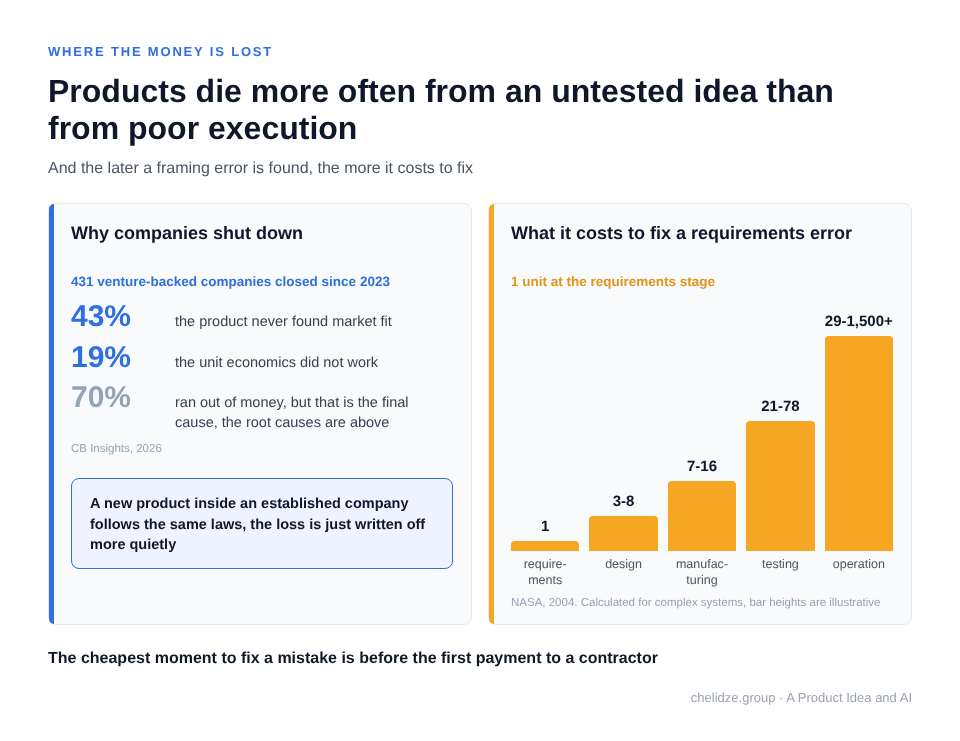
When an executive plans a new product, the usual fear is that the contractor will miss deadlines, get the numbers wrong or go over budget. Products die more often for a different reason. They are launched without checking whether anyone needs them enough to pay and whether the economics work, and by the time this becomes clear, fixing it is late and expensive.
A large sample shows the same. In 2026 CB Insights analyzed 431 venture-backed companies that had shut down. For 43% of them the product never found a market fit, for 19% the unit economics did not work, and two thirds of the market-fit failures were early-stage companies that never found their market. Almost all of them ran out of money (70%), but the analysts say plainly that this is the final cause, while the root causes lie in the market and in the product's economics (CB Insights, 2026). The sample is made of startups, but a new product inside an established company follows the same laws. The loss is just written off more quietly.
The other side of the problem is that a mistake in the problem statement gets more expensive at every stage. NASA calculated that if fixing a requirements error costs one unit at the requirements stage, it costs 3 to 8 units at design, 7 to 16 during manufacturing, 21 to 78 during integration and testing, and from 29 to more than 1,500 in operation (NASA, 2004). The calculation was made for complex systems such as spacecraft, so the exact factors should not be carried over to an app or a new service, but the order of magnitude is familiar to anyone who has had to rework a launched project. The cheapest moment to fix a mistake is before the first payment to a contractor.
What AI has changed
With AI, execution has become cheaper and framing the problem has become more valuable. AI now produces a draft of research, a calculation, a document or a mock-up in minutes, while understanding what exactly needs to be done and why is still the job of the person responsible for the result. For an executive with a product idea this is good news, because the groundwork is exactly what used to stop them from testing the idea on their own.
In an earlier book on a systems approach to digital transformation, in the chapter on product management, I described a universal algorithm for launching a new product. It starts with describing the idea, then goes into detail through customer interviews, a customer journey map, metrics, risks and a financial plan, then early prototyping, a return to the idea with critique, and only after that a minimum viable product. Without AI this path took about 6-8 months and required a team. The method itself has not changed, and I will not retell it here. What has changed is that the executive now goes through a large part of the steps on their own, and the team is needed at the execution stage.
With BAEOS, an executive operating system, the path to a decision took about three and a half months. First we built the first prototype in a month, then spent two weeks talking to the target audience, and based on those conversations we pivoted the idea. The next month went into working through the scenarios and building a clickable prototype, and another month into showing it to the target audience and the conversations the decision was based on. The comparison with the book is not exact, because there the path goes all the way to a minimum viable product, while with BAEOS these months went into prototypes, the pivot and testing with the audience. But this is exactly the part of the path that answers whether to build the product at all, and this is the part that can now be done without a team. It is the experience of one product and should not be taken as a norm.
With the second product, Seknum, a contact assistant and personal CRM, the order was different. First we spent a month talking to the target audience: we tested the idea itself and collected the problems of future users. Only after that did we start building the minimum version for beta testing, and after a month it is 85% done. The fine-tuning and setup of the AI features is under way now, and this is the longest part of the work. Without the AI features the build would have taken exactly one month. Even with the fine-tuning, the whole build will take no more than two months. AI costs for the two months came to $400, which is two subscriptions at $100 a month, to Claude and ChatGPT, with the work done in their development environments, Claude Code and Codex. The subscriptions also covered other work (training, articles, other tasks), and Seknum used about 70–80% of their limits. The two AIs worked as a pair: they double-checked each other and covered each other's weak spots.

Karim Lakhani, a professor at Harvard Business School who chairs its AI institute, describes a similar picture. In his sessions for senior executives, people who know AI, in his words, "third-hand" build an app for their own company's problem in an hour and a half. First they get angry at their CIO, whom they "asked for five years" for the same thing, and then they conclude that if they do not learn AI themselves, they will not be able to lead their teams. This is the observation of one teacher, but it shows how far the line of what an executive can do with their own hands has moved.
The market is moving the same way. Lovable, one of the services where an app is built by describing the task in plain language, reached $600 million in annual recurring revenue by the end of August 2026, with more than 70 million projects created on the platform (AI Magazine, October 29, 2026).
A five-step path
The path from idea to decision is the same for an app, a service and a physical product. The only thing that changes is what you hand to the contractor at the end. At every step AI acts as a sparring partner that asks uncomfortable questions and quickly prepares drafts, while you make the decisions.

Step one: from idea to structure
In an executive's head an idea usually sounds like "customers need this". A good start is to have AI interview you: who exactly the customer is, what problem they solve today and how, what it costs them, why they would pay you. Here AI is most useful as an interviewer and a critic. If you ask it to describe the product straight away, you will get a smooth, middle-of-the-market text in which your idea is no longer there.
Step two: working it through from different angles
Next you look at the idea through the eyes of the market, the customer and the money. AI helps to map competitors and alternatives, estimate the market size, describe customer segments, lay out acquisition channels and work out the unit economics: what it costs to acquire a customer, how much they will bring over the time they stay with you, and where the break-even point is. Once you have the calculation, ask AI to challenge it. Let it name the weakest assumptions and show what happens if each of them moves by 20%.
Step three: the decision to build, not build or change
This is the key step. Everything you got in the first two steps remains a hypothesis, because AI knows the world from other people's texts and knows exactly as much about your customers as you have told it. A decision to build has to rest on live signals, meaning actions by customers that cost them something: an interview a person gave an hour to, a pre-order, a letter of intent, a paid pilot. AI will help you draft interview questions and analyze the answers, but you will have to talk to the customers yourself. This principle is known as customer development. Steve Blank described it in "The Four Steps to the Epiphany" in 2005, Eric Ries built on it in "The Lean Startup" in 2011, and AI does not cancel it, it speeds up the preparation for the conversation with the customer. If there are no live signals, the honest answer is "not yet", and that is an answer too.
Step four: documents
If the decision is to build, you describe the product so that the contractor can estimate it without long conversations. This includes a one-page product vision, a prioritized list of what goes into the first version (must have, nice to have, can wait), usage scenarios and the criteria by which you will accept the work. For software that is a backlog and a specification, for a service a service standard and a service scenario, for a physical product the product requirements and a target unit cost. AI is good at drafting these, and your job is to make sure every requirement can be checked.
Step five: mock-up or pilot
For an app this is a clickable prototype or screen mock-ups, which can now be built without a programmer. For a service it is a manual pilot with a few customers, without automation. For a physical product it is a sketch, a 3D model or a sample. A prototype shows the concept, it does not prove demand, and it does not go into production.
Here is a hypothetical example outside IT. A manufacturing company is thinking of launching an equipment maintenance service on subscription for its customers. In the first two steps the executive and AI describe who on the customer's side is responsible for downtime and what it costs them, and estimate the subscription price and the cost of an engineer's visit. In the third step the executive offers several large customers to sign a letter of intent or pay for a quarter-long pilot. If the customers agree, the executive describes the service standard and service level and runs the pilot manually with the company's own engineers, without a dedicated system. The contractor who later builds the ticketing system receives a tested process and clear requirements.
Sidebar. Five prompts for the five steps
You can use these prompts with any AI assistant. Your own data goes in square brackets. I explained how to build prompts like these in "Questioning AI: Form and Environment".
"Interview me about the idea [two-sentence description]. Ask one question at a time: who the customer is, what problem they solve today, what it costs them, why they would pay us. After ten questions, put the answers together into a one-page description and mark where my answers are weak."
"Work out the unit economics for [product] at a price of [X] and a customer acquisition cost of [Y]. Then name the three weakest assumptions and recalculate the result if each of them turns out 20% worse."
"Write questions for a 30-minute interview with [customer type] to find out whether they have this problem and whether they pay to solve it today. The questions must not suggest the answer and must not describe my product."
"From this product description [paste] build a list of requirements for the first version with the priorities 'must have, nice to have, can wait', and add to every must-have requirement an acceptance criterion that can be checked with a yes or a no."
"Describe the screens of a clickable prototype for the scenario [scenario]: what the user sees, what they press, what happens next. For a service, instead of screens, lay out the steps of a pilot with five customers."
Why this might not work
The first objection to this approach goes like this: this is the job of a product manager and a contractor, and an executive has enough on their plate. That is true, and the executive does not need to become a product manager for good. The point is to go through the path once, at the stage when the question is whether to spend money at all, because at that moment nobody but the executive knows why the product is needed.
The second objection is about the quality of the research. Desk research with AI gives an average market picture, while a business makes money on what differs from the average. I wrote about this in detail in "Why AI Won't Replace the Executive: 4 Reasons", and the limitation does not go away here. That is why in this path the decision is made on live signals from customers, and in the first two steps AI works as a critic.
The third objection is the most serious one: an executive who has built a prototype starts to treat it as a product. A prototype built over a weekend has no architecture, no data protection and no support, and nobody has checked its code for security, so it must not be released to customers. That is why a prototype needs a stated purpose, a deadline and a person you will hand it over to, and after that professionals build the product.
What to bring to the contractor
The outcome of the whole path fits on one page. If you can fill it in, the conversation with the contractor will be about execution.
What goes into the package | Why the contractor needs it | How to check yourself |
|---|---|---|
The decision and its basis: which live signals you received | to know the project won't be stopped in a month | you can name customers who confirmed demand with an action |
The customer and their problem | to build the product for a specific person | the customer is described well enough to find and call them |
Unit economics and target price | to know what unit cost to stay within | the numbers are recalculated with the main assumptions moved by 20% |
Scope of the first version with priorities | to estimate the volume and not build extras | the first version has only what the customer won't pay without |
Scenarios and acceptance criteria | to know how you will accept the work | every requirement can be checked with a yes or a no |
Mock-up, prototype, pilot or sample | to see the concept with their own eyes | real customers have seen it |
Constraints: deadline, budget, data, regulation | not to propose the impossible | the constraints are written down |
Before you go to a contractor, check yourself on three points. At least a few customers have confirmed their interest with an action. The economics work even if the main assumptions turn out 20% worse. The first version of the product can be explained on one page well enough for the contractor to estimate it without a meeting. If even one point is not met, it is too early to go.
What changes in the conversation with the contractor
An executive who has gone through this path comes to the contractor to set the task. That changes the conversation itself. You can ask straight away what the contractor sees as the riskiest part of your package, which requirements they would drop from the first version and why, and what their estimate is made of. A good contractor answers such questions willingly, because a prepared client is easier to work with, and will tell you where your prototype has to be rebuilt from scratch.
The contractor's discovery phase may remain. It will be shorter and will cover their own area (architecture, technology, production), because you have already answered the question of why the product is needed. The contractor is still needed, and the executive should not build the product instead of them. Choosing a contractor, the contract and acceptance are a separate topic, and here the point is what to come to the contractor with.
Instead of a conclusion
If you have an idea for a new product or line of business right now, there are three things you can do this week. Ask AI to interview you about the idea and write down the answers. Work out the unit economics with it and ask it to challenge the weakest assumptions. Talk to five potential customers and see whether any of them is ready to take a step that costs them something. After that you will have either a decision not to build, which saves money, or the basis for a package you can take to a contractor and talk to them as an equal.
Further reading
How an executive can work with AI in practice is covered in Dzhimsher Chelidze's book "Artificial Intelligence. Freefall". Download the free edition.
Training and advisory on AI implementation: on the home page.
Sources
CB Insights. Why Startups Fail: Top 9 Reasons. Updated March 6, 2026
Stecklein J. M. et al. Error Cost Escalation Through the Project Life Cycle. NASA JSC, 2004
AI Magazine. Lovable: Europe's Vibe Coding Platform Crosses US$600m ARR. October 29, 2026
Karim Lakhani, interview with Silicon Valley Girl, October 30, 2026 (23:21).
Blank S. The Four Steps to the Epiphany. 2005; Ries E. The Lean Startup. 2011.


