


PAEI Adizes theory - a system approach tool

Updated: 5 days ago
What do you think is most important in a systems approach ? Where does it all begin?

That's right, from diagnostics. And for diagnostics, we use the Adizes PAEI code, both to determine the stage of the organization’s life cycle and to determine the psychotype of individual managers
Content
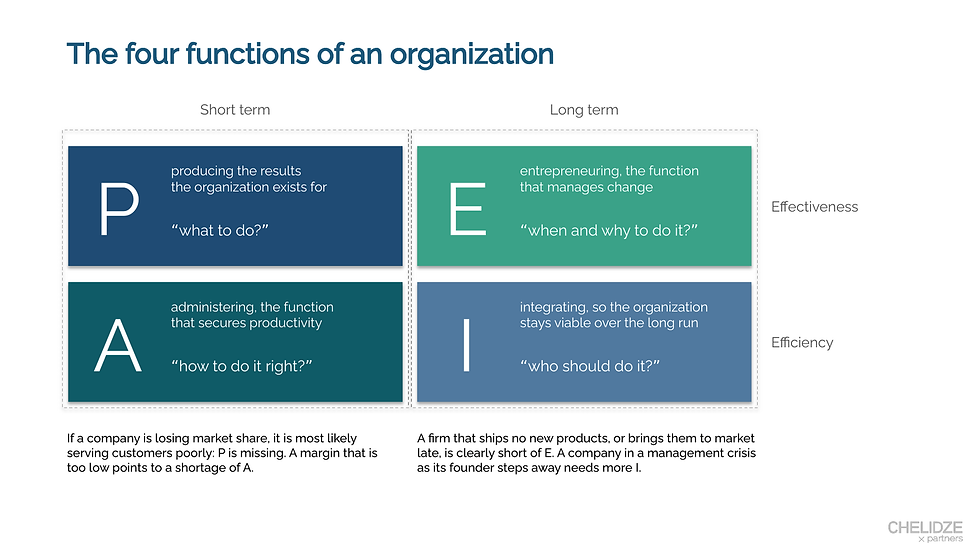
The essence of the theory is that for successful organization and management (at work or at home), 4 functions must be performed:
P - production of results for which the organization exists. Responsible for "What to do?"
The P-function (production) implies the specific execution of work, production of products, implementation of projects, etc. The importance of this function for the organization is that it ensures its financial stability and profitability. Organizations whose work is related to the execution of production tasks must develop this function more actively in order to be competitive. This function is responsible for short-term performance
A - Administration that ensures performance. Responsible for "How to do?"
A-function (administration) is associated with the organization of work: resource allocation, compliance with rules and regulations, ultimately ensuring efficiency in the short term
E - entrepreneurship, through which change management occurs. Responsible for “When and why to do it?”
The E-function (entrepreneurship) is associated with initiative and risk-taking, market research and creating new opportunities for the organization. The significance of this function is that it ensures the growth and development of the organization in an unstable market. Ultimately, she is responsible for long-term performance
I - integration, unification to ensure viability in the long term. Responsible for "Who should do it?"
I-function (integration) is associated with coordinating activities and establishing relationships between different functions and people in the organization. The significance of this function is that it ensures the harmonious work of the team and promotes a high level of synergy. It is responsible for long-term effectiveness.
This is how Adizes himself describes the influence of the components: “If a company is losing market share, most likely it is not meeting the customer’s needs well, that is, there is not enough P. A rate of return that is too low indicates a deficiency of A. The company does not release new products or is late in introducing the product to the market - clearly not enough E. If a company experiences a management crisis when its founder retires, you need to add I. ”
PAEI code and life cycle
Every organization goes through stages of its life cycle: infancy, adulthood, flowering, aristocracy, aging and death. And for each stage there are characteristic features for it and the components necessary for this stage must be used.


And each stage requires its own strategy and priorities

PAEI function conflict
The ability to perform one function will likely reduce the ability to perform the other. This is explained very simply: the four functions cannot be considered mutually exclusive, but they are incompatible in the short term.
Conflict between (P) and (E)
Production (P) and entrepreneurship (E) conflict because (P) requires quick returns, while (E) seeks to provide them in the long term. The reverse is also true: (E) threatens (P). Entrepreneurship involves change, and this jeopardizes the fulfillment of the (P) function. There comes a time when you need to stop making plans in order to start implementing them.
Incompatibility (P) and (A)
(P)/(A)-incompatibility is a struggle between form (effectiveness) and function (effectiveness). If you want to achieve high performance (P), then you can hardly count on efficiency. This is why young companies that constantly “put out fires” and face unforeseen problems are disorganized and ineffective. They are forced to put up with the fact that organization and order have to be postponed until later. The opposite is also true: while being highly efficient, you will eventually lose in effectiveness. In other words, by overdoing (A), you will reduce (P). This is exactly what happens in bureaucratic systems, where every detail is planned and every change is strictly controlled.
Incompatibility (A) and (I)
(A) is detrimental to (I) because it forces the organization to rely on mechanical rules and procedures. Such an organization will be less focused on internal and cultural values. Making laws is easier than forming value guidelines. It only takes a few months to create a law. It takes a lifetime to form a new moral code. Moreover, sometimes (A)-rules can contradict (I)-values. The more attention you pay to (A), the weaker (I) becomes. And vice versa: the stronger (I), the less your need for (A). However, this is a positive incompatibility. If (I) inhibits the development of (A), this is desirable.
(P) threatens (I), (I) threatens (P)
(P) displaces (I). When there is an urgent need to produce results, that is, to ensure the fulfillment of the (R)-function, it is quite forgivable to become a dictator for a while, without paying special attention to integration and the needs of individual stakeholders. It is also true that (I) undermines (P). People who are united by (I) relentlessly adhere to the criteria of their own value system, which damages their ability to (R). Even if it is a matter of life and death, they will never break the rules.
Fight between (E) and (I)
(E) thirsts for change, strives to create and make changes, while (I) seeks harmony, agreement and integration. What (I) seeks to unite or keep together, (E) seeks to dismantle into parts. Excess (I) and deficiency (E) prevent you from adapting to what is happening and speeding up.
Conflict between (E) and (A)
Entrepreneurs (E) are radical, administrators (A) are conservative. Administrators strive to tighten controls to maximize efficiency and try to achieve this by minimizing variation. Entrepreneurs live to create the disruption and change that is necessary to achieve long-term performance. Thus, (E) poses a threat to (A) because too much change interferes with systematization, routine, and order. Of course, the opposite is also true: (A) is dangerous for (E). Procedures, rules and regimented behavior hinder change.

As we can see, all functions conflict with each other. And the combination of all functions in one person is virtually impossible, which is why we come to the need for a team in which the necessary functions for each direction will be closed. Hence I. Adizes introduced the vitamin formula - each function requires one main vitamin and one auxiliary

Main rules
When launching a business or product, the organization cannot be allowed to be old in terms of components
You need to focus on the must-haves
At the same time, it is important not to fall into the traps of each stage of the life cycle, and this requires balance and the elimination of failures
For each function there are dominant and auxiliary functions that also need to be focused on
The organization can be “rejuvenated”. To do this, it is necessary to adjust the strategic goals, organizational structure and approach to describing and working with business processes, and change the types of communications

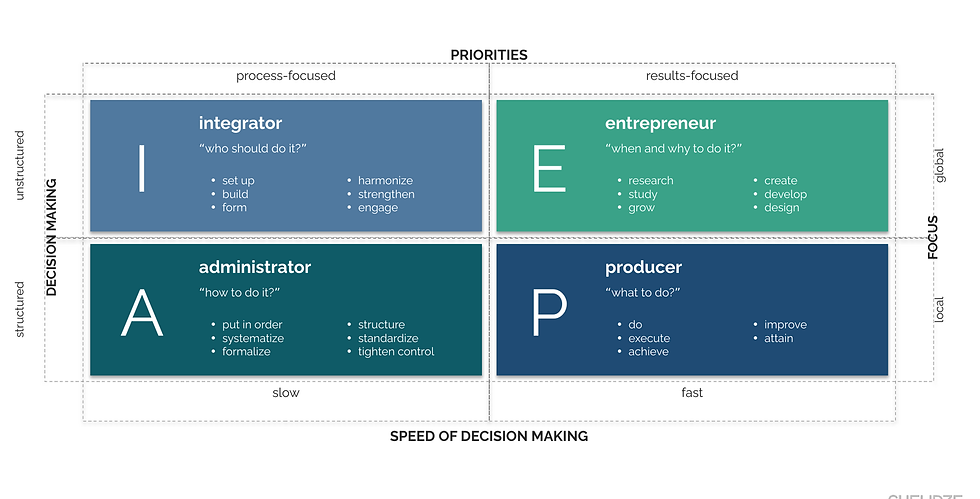
The Adizes PAEI code is also excellently used to determine the decision-making style and personal qualities of various managers and executives. The key rule is that the leader should not have dashes. That is, all functions must be developed at a basic level, plus 1 dominant function.
P-managers
He is a creator who has excellent knowledge of the technology in his field, which is necessary to achieve results. The manufacturer sells, designs, manages the production system, or conducts research. Incredibly competent, knowledgeable, proactive, diligent, driven and driven. He works all day long, tirelessly. His main mission is to accomplish the task. You can always rely on such a person, being confident that he will not stop halfway and will certainly bring the job to the end.
Detailed description and recommendations for P-managers follow the link
Communication strategy with P-manager
A producer is a leader who is highly productive and action-oriented. Responds best to clear instructions and specific goals. Prefers to communicate concisely.
It is not recommended to communicate with the Manufacturer in too many words and overload him with details.
If you want your message to be heard, you must address it directly and clearly.
The main task: to focus it and prioritize the task.
The main thesis in the argument: “If this problem is not solved, there will be a disaster.”
A-managers
The administrator systematizes the work, controls the budget and costs, in other words, he implements the company's action plan. Its code is pAei. He copes brilliantly with administration, while at the same time he has a decent level of technology, knows how to plan and shows interest in people.
A type A manager thinks linearly. His actions are consistent, well thought out and properly organized. He is an ardent opponent of chaos who loves to control the situation and finish what he starts. A-type subtly notices details, weighs alternatives, and pays close attention to the accuracy and reliability of information. All these qualities help him anticipate possible problems even at the stage of the idea’s inception.
Also, such managers often have an increasing coefficient - they try to allocate more time and resources than necessary. For example, a task requires 1 month, they will try to budget 2-3.
Detailed description and recommendations for A-managers follow the link
Communication strategy with A-manager
An administrator is a leader prone to control and organization. It responds well to details, classification and structured data. Prefers to communicate via text messages and can be very demanding about the accuracy and quality of information.
If you want your message to be heard, you must provide enough information and make sure it is accurate and structured.
Main task: demonstrate the security of the solution and minimize risks
The main thesis in the argument: “We have worked through various options and this is the safest.”
E-managers
It is thanks to Entrepreneurs that an organization is able to change along with the market, can become effective in the long term and outperform competitors.
The PAEI code of an Entrepreneur looks like this: PaEi. He is a creative and purposeful person. Being enterprising and energetic, he works tirelessly all day long, occasionally embarking on adventures. Thus, the Entrepreneur is able not only to develop a plan of action (performs the E-function), but is also willing to take risks in order to bring his ideas to life (performs the P-function).
In addition to the fact that (PaEi) outlines new strategies, initiates and implements changes, he has administrative skills (A) and gets along well with people (I).
The Idea Generator (paEi) differs from the Entrepreneur (PaEi) in that he has poorly developed P-skills. He generates an inexhaustible number of innovative ideas and has difficulty implementing them. How can we explain this? He is captivated by the decision-making process itself, but when it comes to implementing it, he lacks the patience and endurance to see it through to completion. At the same time, he is able to listen to other people's opinions and knows how to notice details.
Entrepreneurs also encounter a reduction factor - if they think that a task requires a month, then in reality it must be increased by 2,3,4,5 times. The more clearly the E-function is developed, the higher this coefficient will be. It appears due to the fact that such people “fly on the ground” and do not see small details.
Detailed description and recommendations for E-managers follow the link
Communication strategy with the E-manager
An entrepreneur is a leader prone to innovation and initiative. Usually this is an energetic and straightforward person in communication. Likes to use visual materials to illustrate his ideas, communicate at the level of ideas and concepts. You should not communicate with an Entrepreneur in a too formal and boring manner.
If you want your message to be heard, you must present your ideas in an interesting, engaging, and forward-looking way.
The key task: to put an idea in him, but leave something unsaid and guide him so that he can have the last word, and the idea becomes his.
The main thesis: “We can turn the world around. No one has done this before.”
I-managers
I-type easily establishes connections and interpersonal relationships, forms a team and develops the potential of colleagues and subordinates. All this allows us to unite the organization, successfully implement ideas and achieve results.
How does the Integrator differ from other PAEІ types? I-people are sensitive individuals. They tend to be empathetic and have deductive thinking. In other words, they have a good understanding of the difference between what a person said and what a person meant to say. But the most important difference is that they remember not only their own interests and are always able to put themselves in the place of another. In particular, for this reason, this type of leader becomes good managers.
Detailed description and recommendations for I-managers follow the link
Communication strategy with I-manager
An integrator is a leader who is prone to social interaction and establishing contacts with other people. Usually prefers to communicate in person or by phone, that is, using voice and live speech. You should not communicate with the Integrator via email or instant messengers, since he cannot express his thoughts correctly in text format.
If you want your message to be heard, you must make personal contact.
The main task: to show that the decision is safe and was accepted by the team
The main thesis in the argument: “We discussed and supported everything. This is a collective decision."
Every manager and executive can be classified into one of these categories, and knowing their strengths and weaknesses can help improve management effectiveness.
Erroneous styles

P--- - lone ranger, lone hero
Works for the whole group, results-oriented, purposeful and active, persistent, good performer. But he does not know how to control and organize, delegate powers, does not know how to think creatively, there are no new ideas; does not understand people, their feelings, does not understand interpersonal relationships.
-A-- - bureaucrat
Knows how to put things in order in papers and actions, knows how to analyze data, is picky about details, manages with the help of directives, knows how to control subordinates, and details all current documentation. But he does not know how to take risks, never departs from planned events, sits a lot and attaches importance to little things, does not like changes and innovations.
--E- - arsonist
A hyperactive and even adventurous person. He loves transformation and new ideas, knows how to inspire others, is focused on short-term results, works hard and makes others work overtime, likes to create new things, abandoning the old, is active and eloquent in his thoughts. But he does not know how to negotiate with people, he can be aggressive, suspicious, does not know how to listen, is emotional and expressive in conversation, does not know how to bring things to the end, and often turns the majority of his subordinates against himself with nagging and unfounded accusations.
---I - super follower
Focused on team integration; loves comfort, is attentive and charming, listens to authorities and influential people; carefully monitors the attitude towards himself, tries not to create disagreements, does not like conflicts, loves to communicate with people. He does not know how to listen to people, does not delve into details, is inconsistent, easily gives up his promises, withdraws from decision-making, does not see prospects and does not know how to take risks, does not know how to formulate goals and achieve them.
---- - dead stump
He practices friendliness, charm and courtesy, is satisfied with himself and his position, never refuses something new, but does nothing for it. Does not know how to take initiative, is ineffective, does not like changes, subordinates do not know what needs to be done, does not learn and does not allow others to learn, is conservative to the point of pathology, there is no purposeful activity.
Conflict between speakers of different styles
As you might guess, people of different styles do not like to work together.

But what to do? After all, a management team should consist of representatives of different styles. And employees of different departments need to communicate with each other.
We use the principles of business etiquette and mutual respect. We wrote more about the work of etiquette in communication here
We provide training to employees so that they learn to be aware of themselves, their personality, and other people.
We conduct a simple game to create awareness of the need for cooperation
Sit alone, or better yet with your partners/colleagues in one place
Write down 5 problems that you faced 3-5 years ago
Write down 3-5 of today's most pressing problems
Compare these problems
Which ones can you solve on your own?
Is it possible to solve all this with formal business processes and regulations, IT systems?
What AI Changes in the PAEI Model
For half a century the four functions cost roughly the same to fill. A strong producer is hard to find, a strong administrator is hard to find, an entrepreneur is hard to find. The difference was in temperament.
That stopped being true over the past two years. Generative AI left the model untouched and rewrote the economics of the roles.
What the Machine Takes and What Stays With You
Function | Question | What AI already takes | What stays with the human | Sign the cell is empty |
|---|---|---|---|---|
P, producing | What to do? | Documents, calculations, data roll-ups, standard letters, triage of incoming requests | Accepting the result and answering for it | Work stops whenever one specific person is on holiday |
A, administering | How to do it? | Draft procedures, checklist reviews, reminders, reporting | Deciding which rule to introduce and which to drop | The procedures exist and nobody follows them |
E, entrepreneuring | When and why to do it? | Testing a hypothesis, finding analogues, weighing options | Seeing the problem before it becomes a task, and placing the bet | Every item in the plan arrived from outside: the market, the boss, the regulator |
I, integrating | Who should do it? | Meeting notes, distributing agreements, workload summaries | Resolving conflicts and holding people together, now with agents in the room | People work, the team does not exist |
The top two rows are getting cheaper. The volume of that work used to be capped by the number of hands; now it is capped by a token budget, and those are limits of a different order. Administration follows the same path more slowly, because it lives inside internal systems the machine still has to be let into.
The third row is getting more expensive. Here is why.
The Formula
Execution got cheaper, framing got dearer. AI solves a stated task quickly and at low cost, but the problem is found and put into words by whoever sees it.
The formula grew out of two episodes of my own.
First episode: work on a new edition of my book. When you try to pull something new out of the model, it gives you nothing but optimisation of what is already written. You can circle around and come at it from different angles, and the result stays at zero. But the moment you share an observation of your own, it finds the place in the book where that observation belongs, the argument for it, and the way to sharpen the thought.
Second episode: work on a product. The model takes my idea apart and shows the upsides and the downsides, and it does that well. Ask it for an alternative, and you get the average-grade ideas that everyone on the market already has.
In Adizes terms both episodes say the same thing. P and A the machine closes. E you have to bring yourself, and bring by hand.
A recent example, usually cited against this very conclusion. On 20 May 2026 OpenAI reported that its internal reasoning model, not trained specifically for mathematics, had disproved Erdős's 1946 conjecture on unit distances. Noga Alon called it an outstanding achievement that settled a long-standing open problem. Timothy Gowers, a Fields medallist, gave the same verdict: a milestone in AI mathematics. A year earlier, on 14 May 2025, AlphaEvolve found a way to multiply complex-valued four-by-four matrices in forty-eight scalar multiplications, improving on Strassen's 1969 algorithm.
It looks like a refutation until you sort out who did what. The model did not pick the problem: it was handed one from a curated set of Erdős problems, in a test of whether models can contribute to frontier research. Erdős himself posed the question eighty years ago. External mathematicians verified the proof and wrote the companion paper. Will Sawin of Princeton later sharpened the result to a specific constant. The model travelled the road from a stated question to a verifiable answer, and travelled it better than people. Inventing the question, and deciding it mattered, was never its assignment.
The second case gives even plainer numbers. AlphaEvolve was set loose on more than fifty open problems. In roughly 75 per cent of them it rediscovered the best solution already known, and in 20 per cent it improved on it. Three runs out of four returned what humanity already had.
There is a counterargument, and it deserves quoting. Commenting on the Erdős result, Arul Shankar said that models have gone beyond being helpers to mathematicians and are capable of genuinely ingenious ideas. I will not argue: inside a stated problem with a verifiable answer, that is exactly right. The border runs elsewhere. Who states the question, and is there anything to check the answer against. In mathematics the problem is written down in full and the check is built in. On the shop floor, in a negotiation, in a conversation with a client, the problem is written down nowhere. Someone has to notice it.
What This Means for Your Team
The rule about the baseline level still holds. What changed is the price of an empty cell. P is now filled by a tool in weeks, A in months, and it is filled in the work rather than in the person. The empty cell under the entrepreneurial function is not cured by any tool, and it is the most expensive hole in a management team.
Who is worth hiring changes too. A strong producer without an assistant loses to an average producer with one, and the gap keeps widening. With the E function there is no symmetry: the machine gives its holder speed in testing hypotheses, not the hypotheses themselves.
Can the Team Be Compressed to One Person
The table above invites a conclusion that is now sold under the name "one-person company": since the machine takes over P and A, keep one person with agents. Adizes answered this long before AI. There is no ideal manager who performs all four functions at a high level, and not because people lack talent. The functions conflict with each other: P lives on today's result while E bets on what does not exist yet; A demands a rule while E breaks it; I gathers people while P has no time for them. No one person is strong in all four at once, which is why management is the work of a complementary team in which each function is held at a high level by someone of their own.
AI has not shifted that conclusion. It has sharpened it. Look at the column "what stays with the human": the machine takes execution, while accepting the result, deciding on the rule, making the bet and resolving conflicts stay behind. That is Adizes's four functions in their pure form, stripped of the routine that used to dilute them. In a one-person company all four land on one person, and the agent does not rescue you here: it executes what it was told, but it does not hold a function and does not resolve the conflict between functions on your behalf. The one-person company is the old myth of the ideal PAEI manager with agents in place of subordinates.
So the compression is real, and steep, but it does not go down to one. A solo expert selling their expertise gets stronger with agents: at their scale a threshold level in all four functions is enough, and the error lands on them. A company that builds a product shrinks to a small team where the four functions are spread across different people and agents multiply each of them. There is a second argument as well, about subject knowledge rather than functions: in every domain where the client pays for the error, the machine's result must be checked by an expert who can do without it, and no one person is an expert in everything. It is set out separately, together with a way to size your own minimum team, in the article "The One-Person Company Is a Utopia. Even in the Age of AI".
Why Finding Ideas Will Get Harder
The formula has a second floor, and it is nastier than the first. The machine takes the standard tasks and then the standard problems with them. Anything visible in the data, in the procedures, in a comparison against the market, it now finds faster and cheaper than any analyst. The average-grade insight is running out: it will be produced before you and without you.
The bar for what counts as an insight rises. What remains is what the data does not hold and no report can yield. Things like that get noticed in the work, in the friction you feel with your hands. And here comes the second blow: the more of the routine goes to the machine, the less often you meet that friction. Framing gets dearer from two directions. Relatively, because execution got cheap. And in substance, because insights got harder while the raw material for them got scarcer.
One risk in this reasoning has to be cleared up straight away. AI does expose bottlenecks: remove one constraint and the next becomes visible. What disappears is the class of problems visible only from doing the work. A disproportionate share of breakthroughs historically grew out of small friction on the execution floor, which makes the loss easy to miss and therefore dangerous.
How to Check This on Yourself
The inner feeling of «I do see the problems» is worthless: from the inside, understanding and the illusion of it are indistinguishable. You need an external sign, and I use two.
The first works on a single decision. Name the assumption your decision violates, and say what you pay if you are wrong. No assumption violated, and you are looking at an optimisation: give it to the machine. There is one, and it is your bet, with the machine as the packager.
The second is counted by quarter. Count how many problems over three months you named yourself, rather than received as a ready-made task from the market, your boss or your subordinates. If the count is near zero, your E function exists on paper and not in practice.
The Link to IT and Digital Roles
A common mistake: handing the digital transformation agenda to the IT director. In Adizes's terms these are different people. Administration and production dominate in the IT director. In the head of digital transformation, entrepreneurship and integration come first. The argument used to be about competencies. Now it has an economic footing: AI gets cheaper in precisely the letters where classic IT is strong, and does not cover the one the transformation function is created for. How to separate these roles in practice is covered in Dzhimsher Chelidze's book «Artificial Intelligence. A Practical Implementation Guide».
Adizes theory is an excellent tool that combines simplicity and effectiveness.
We've used it in corporations, federal agencies, and startups. And it demonstrated performance in 100% of cases. Also, Adizes’ theory formed the basis of our systematic approach and allows us to understand what needs to be focused on first.
Recommendations :
Form a team of speakers of different styles
When selecting people and distributing them according to areas, it is necessary to take into account the employee’s psychotype
The business life cycle stage must correspond to the PAEI profile. In this case, it is necessary that there are no sinking functions
In order for employees of different psychotypes to be able to communicate, either a leader is required, or everyone needs to have a developed I-function and another one according to their activity profile.
As a result, the MAIN rule of Adizes’ theory, no matter if we are talking about a company or a person, is that there should be no dashes. That is, all functions should always work, some dominate, some at a basic level.
Useful files:
Recording of the webinar
Useful links:

